Why Collage and Parts Work Belong Together
I didn't set out to combine these. I was doing my own IFS work, and I kept running into the same wall.
I could name my parts. I could describe them in session. But I couldn't hold the whole picture at once. The part that pushes and the part that shuts down were clearly in some kind of relationship, and I could never quite see what it was.
So I started making parts maps. I wanted to look at the thing instead of just sitting with it in the session and only talking about it. I'd sit down with magazines and scissors and put images to whatever I was carrying that week, and something would show up on the page that hadn't shown up in conversation.
That's where Inner Mosaic came from. I've been running the group for almost a year now, and it's turned out to do something I didn't fully anticipate.
A quick word on parts
Internal Family Systems starts from the idea that you aren't one unified self with a defect to correct. You're made up of parts, and each one developed for a reason.
There's usually a part that criticizes you first, because being criticized by yourself hurts less than hearing it from someone else. A part that keeps you busy. A part that reaches for the drink, or the phone, or the fourth hour of work. These parts are not the problem. They're the solution to some older problem, still running long after the situation changed.
The work is getting to know them rather than getting rid of them.
Why seeing them changes things
Talking about a part keeps it partly inside you. You're describing it from within the same system it lives in.
Putting it on paper does something different. Once an image of that part exists outside your body, you can look at it. You can notice it's sitting in the corner of the page, or taking up two-thirds of the space, or positioned with its back to everything else. You didn't decide any of that consciously, which is exactly why it's useful.
This is what therapists call externalizing, and it's not specific to collage. But collage does it unusually well.
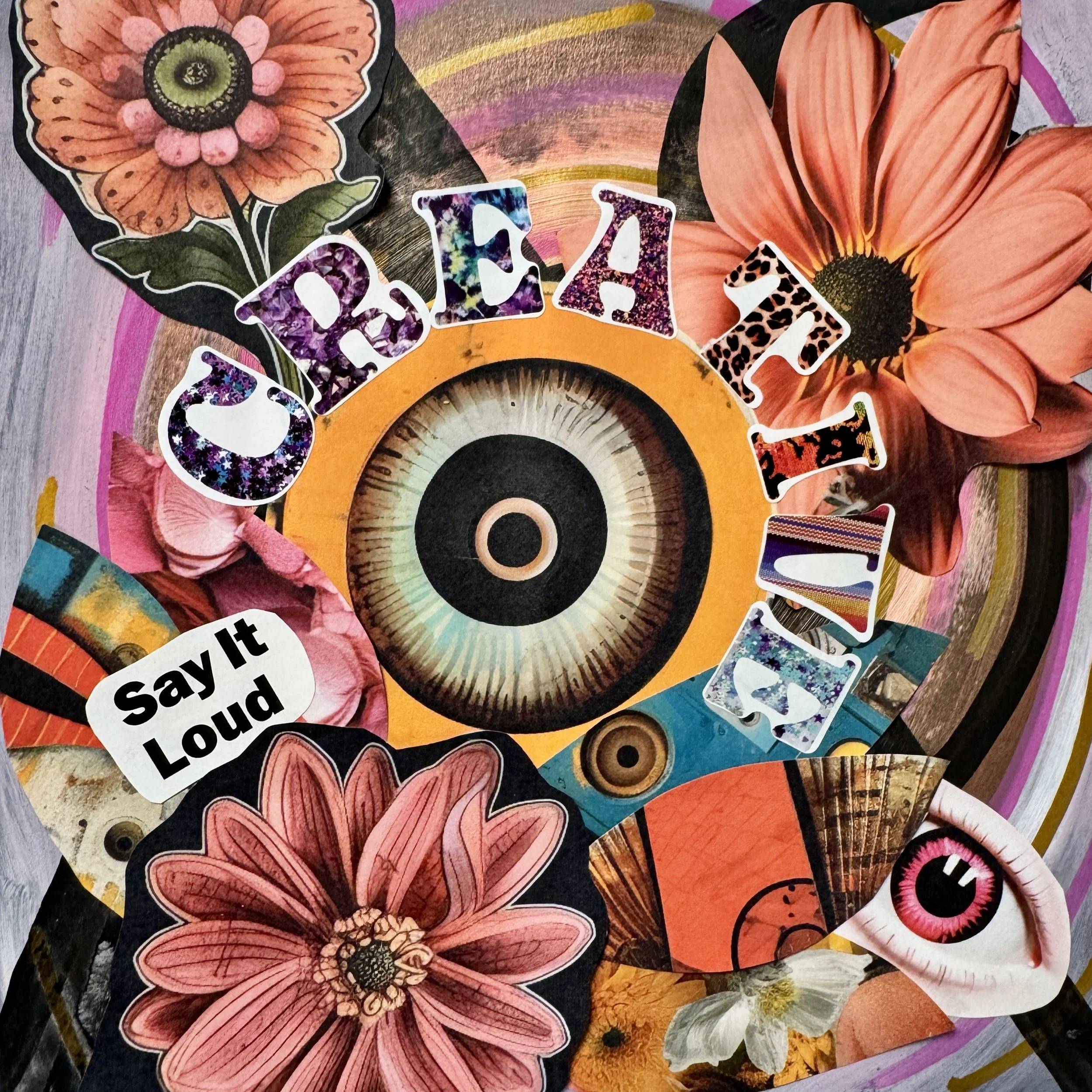
Why collage specifically
There's no skill barrier. Ask someone to draw their inner critic and most people freeze, because now they're being evaluated on drawing. Hand them a stack of magazines and the question changes to "does this one feel right," which almost everyone can answer.
The images are already made. You're choosing rather than producing, which quiets the part of you that wants to get it right. People routinely pick an image without knowing why and understand it twenty minutes later.
It bypasses language. A lot of what parts carry arrived before you had words, or in situations where words weren't safe. Images can hold things sentences flatten.
It's fast and it's forgiving. You can rearrange, cover something up, start over. Nothing is permanent, which matters when you're working with material that feels tender.
Try a parts map yourself
You don't need a group or a therapist for this. You need a stack of magazines, scissors, glue, and about forty minutes.
1. Pick one situation. Something recent and specific. A conversation that went sideways, a decision you keep circling, a day you felt off.
2. Ask who showed up. Not what happened. Who in you was present? The one who wanted to leave, the one who smoothed it over, the one who replayed it for three hours afterward. Two or three is plenty.
3. Find an image for each. Don't overthink it. Flip until something catches. You're not looking for a literal illustration, just something with the right feeling.
4. Place them before you glue. This is the part that does the work. How close are they to each other? Which one is in front? Is anything hiding? Move them around and notice what feels accurate versus what feels wrong.
5. Glue it down and sit with it. Then ask each one what it's worried would happen if it stopped doing its job.
That last question is often where the whole thing opens up.
About Inner Mosaic
Inner Mosaic is a monthly collage workshop I run in Vancouver, WA. It's three hours of guided meditation, collage journaling, and reflection alongside other people doing the same thing.
A few things worth naming clearly. This is a facilitated creative workshop, not group therapy and not art therapy. There's no requirement to share what you made or explain anything about your life. Some people talk. Some people work quietly the whole time and leave. Both are completely fine.
You don't need any art experience. Genuinely, most people who come have none, and the ones who arrive most convinced they aren't creative usually make the most interesting work.
All materials are provided. You bring yourself.