When You Can't Tell Which One It Is
A lot of first-generation adults arrive in therapy having already done the research. They've read about ADHD. They've read about anxiety. Somewhere along the way they came across complex trauma and something went quiet in them.
And then they get stuck, because every description fits and none of them fits completely.
That confusion is reasonable. These three genuinely overlap, they frequently occur together, and the particular circumstances of growing up between cultures make them unusually hard to separate.
Where they blur
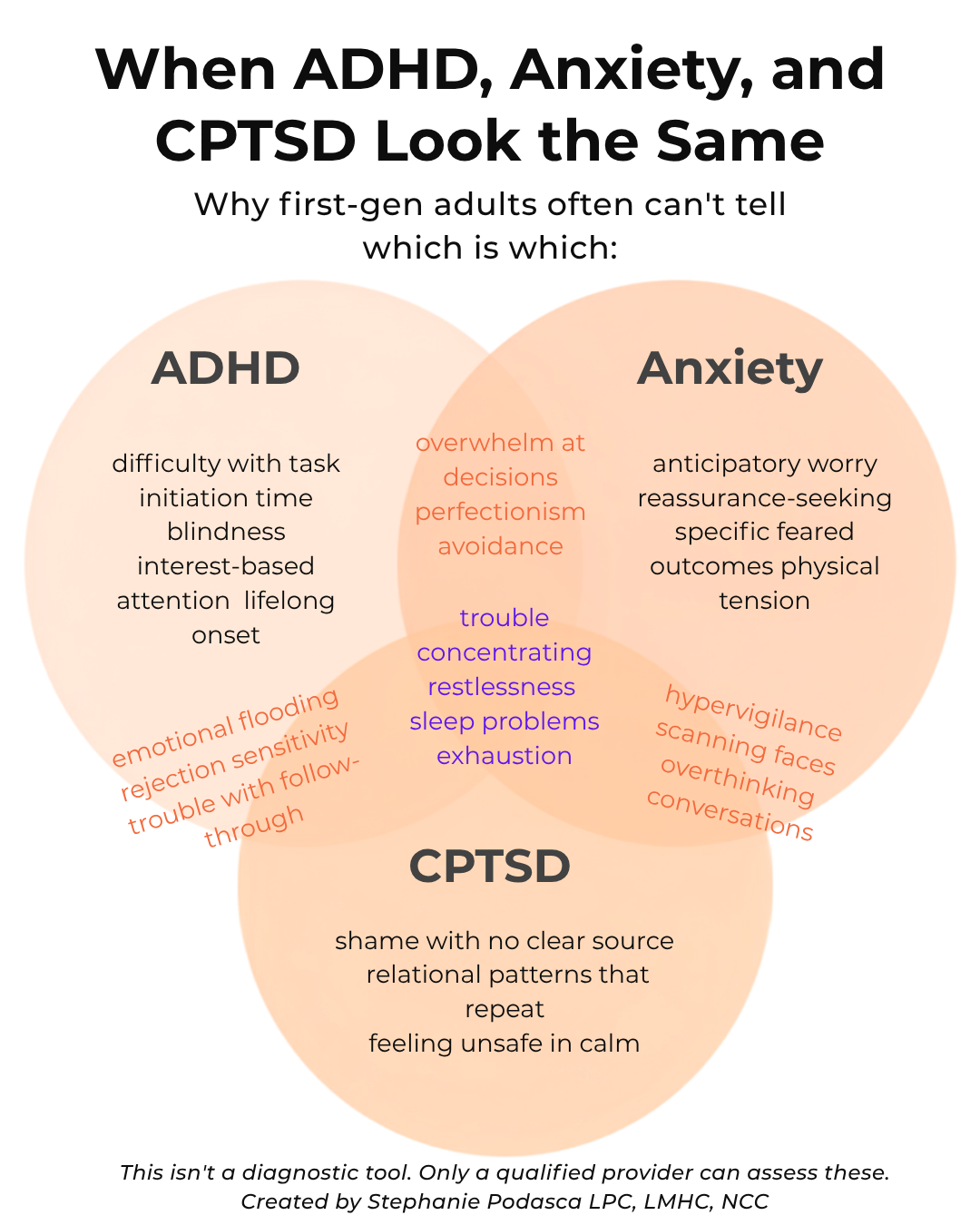
Consider a few symptoms and where they could be coming from:
Trouble concentrating. ADHD affects attention regulation directly. Anxiety occupies working memory with threat monitoring, which leaves less available for anything else. A nervous system shaped by years of alertness stays partly oriented outward, scanning, which is not a state that supports focus. All three produce the same visible result.
Restlessness. Could be ADHD's difficulty with stillness. Could be anxiety's activation. Could be that being still has never felt safe.
Emotional intensity. ADHD often involves difficulty regulating emotional response. Complex trauma tends to produce either flooding or numbness with little in between. From the outside, both look like a lot of feeling.
Trouble with sleep, follow-through, and rest. All three. Reliably.
You can see the problem. The symptom tells you something is happening. It does not tell you what.
Why this lands differently when you're first-gen
Three things make the picture harder to read.
Some of it was adaptive, and everyone around you was doing it. If you grew up reading your parents' moods before you read English, hypervigilance was not a symptom. It was a job. If you translated at doctor's appointments at nine years old, managed adult logistics as a child, or learned to anticipate a shift in the room before anyone spoke, that skill got you through. It's genuinely hard to identify something as a trauma response when it was the thing that kept your household running, and when it looked the same in every house on your street.
The comparison point was calibrated differently. Many first-gen adults measure their childhood against what their parents survived. A parent who left a war, a regime, or real poverty sets a bar that almost nothing else clears. So you conclude that what you experienced doesn't count, and you go looking for a different explanation for why you feel this way.
Diagnosis came late, if it came at all. Getting evaluated for anything requires access, a family that considers it worth doing, and a system that recognizes what it's seeing across a cultural difference. Plenty of first-gen adults reach thirty having never been assessed for any of this. What they have instead is a decade of being told they were sensitive, dramatic, lazy, or too much.
The risk runs both directions
This is the part I want to be careful about, because both errors do damage.
Attributing everything to trauma can cost someone an ADHD diagnosis they need. ADHD is a real neurodevelopmental condition with effective treatment. Deciding that a lifetime of attention difficulty is "just trauma" can keep someone from an evaluation that would change their life. If you suspect ADHD, get assessed. Trauma work is not a substitute for that, and a trauma history does not rule it out.
Attributing everything to ADHD can leave the trauma untreated. Stimulant medication may improve focus while the hypervigilance, the shame, and the relational patterns continue exactly as they were. Someone can be genuinely helped and still be carrying what they came in with.
And very often it's both. These co-occur frequently. Having one does not protect you from the other, and treating one well does not address the other.
The more useful question is what's actually happening in you, where each piece came from, and what each one needs.
What helps?
Get properly assessed if ADHD is a live question. A real evaluation, not a quiz. Your therapist can support that process and should not be the one making that call informally.
Work with the nervous system, not only the thoughts. If the alertness is old, insight alone rarely resolves it. Body-based work gives you access to what talking cannot reach.
Use a model that doesn't require you to pick a side. I work primarily through Internal Family Systems, which treats the part of you that scans, the part that spirals, and the part that goes blank as separate and understandable, each with its own history. You don't have to decide what to call the whole thing before you start understanding the pieces.
Find someone who understands the cultural layer. You shouldn't have to explain the basics from scratch. That takes energy you could be spending on the actual work.
One more thing…
A lot of people arrive at this question already convinced they're exaggerating. That the comparison to their parents settles it. “Other people had it worse.” That might be true, but it also doesn't change what you're carrying.
You're allowed to need support for the life you actually lived, including the parts that looked functional from the outside and especially the parts everyone around you treated as ordinary.
I offer therapy for first-generation and bicultural adults in person in Vancouver, WA and online throughout Washington and Oregon.
Learn more about first-generation therapy or schedule a free consultation.